
THE BEGINNING
THE PORTA MAGICAE PROJECT
We have to start somewhere, sometime—why not here, right now?
The Porta Magicae Project is not just one, but many beautiful projects that we seem to walk right into when we travel. You cannot accompany a newborn baby turtle on its first journey to the sea, swim with a group of curious penguins, or make eye contact with a young whale that has decided to “mug” you and not fall in love with them. You can’t hang a hammock in the rainforest and leave two weeks later without feeling that you’ve become Mother Nature’s new best friend—and we always make friends. But here and there, sometimes they need a hand. Thus, special projects emerge as we get to know the people and the animals and see the locations firsthand. We put our brushes and pens to work, the best tools we have, since it is what we do, and find new ways to help because at times, time is crucial.
We strongly believe in our mission to create a universe of stories for children of all ages designed to bridge cultural divides. In the universe we dream about, friendship knows no borders. To craft this universe, in the spirit of Porta Magicae, we collaborate with writers, researchers, anthropologists, biologists, architects, sociologists, librarians, educators, students, painters, illustrators, graphic designers, animators, videographers, producers, musicians, and composers—creative minds from all walks of life—and importantly, from everywhere and everywhen!
The Porta Magicae Project encompasses everything and everyone that passes through our magic doors: our books, our team, our travels, our classes, our social media, our readers, and our supporters. In these projects, we need you. We need your ideas. We need creative solutions. We need your collaboration. Our door is always open, and time is of the essence. Going through our door could be your first step to getting involved with projects you will always love. We know we do.
These projects are an important vehicle to achieve our mission. So, we have teamed up with organizations, groups, individuals—friends who have taken it upon themselves to find creative solutions to challenges and time-sensitive issues that affect us all, and we are creating projects focused on environmental conservation, social justice, education, healthcare, animal welfare, community development, and more, to aid them in their quests in any way possible. We use pens and brushes. What are your tools? How can you best get involved? You don’t have to be an artist; your ideas will do. Contact us!
So read on, and learn how many people around the world—people like you—are already coming up with beautiful, creative ideas to help their communities—and while it might seem in a very small way, together, we help us all.
This is just the beginning. The projects we present here are just a few of many that are in the process of being developed—they are designed for young, adventurous, and inquisitive minds, as well as for all those interested in using them for instruction and education.
Please visit us often for the latest updates, or scroll to the bottom of this page to subscribe.
PROJECTS IN THE MAKING
DRAWING BABY ANIMALS PROJECTS
With our “Drawing Baby Animals” project, we are adding our grain of sand. We believe that we can be of help by starting a program with schools to teach children, and their teachers, how to draw baby turtles—and many other baby animals—while also shearing with them fun facts about their important journey.
The concept is simple:
“Drawing animals can instill a love for their conservation. Learn about the animals, their life journeys, and how to draw them yourself—and share your knowledge with your friends!”
The plan is simple:
We have contacted partners in different countries to be our voice at local schools for the project.
We are making available short videos and downloadable visuals—free to schools on our website.
We are first focusing on communities where certain species are in most need, then expanding.
Longer, more advanced and complete videos for young adults (and adults of all ages) will become available for a very low fee, and part of the proceeds will go to partner institutions that are already working toward the conservation of the species in need in their areas. Coloring books and printed materials could be made available for those communities with no access to the internet.
With time, kids can learn how to draw and have information on a collection of animals from the world over.
THE LITTLE TURTLE’S LONG, LONG JOURNEY
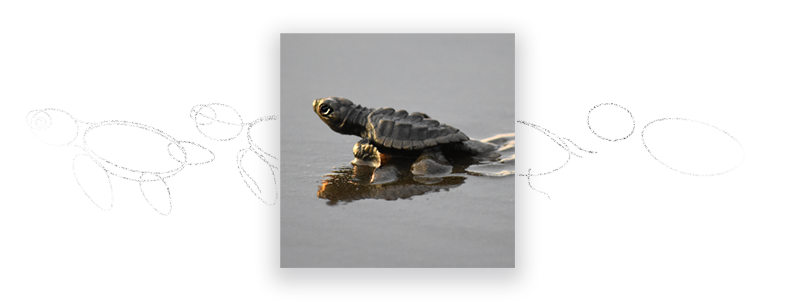
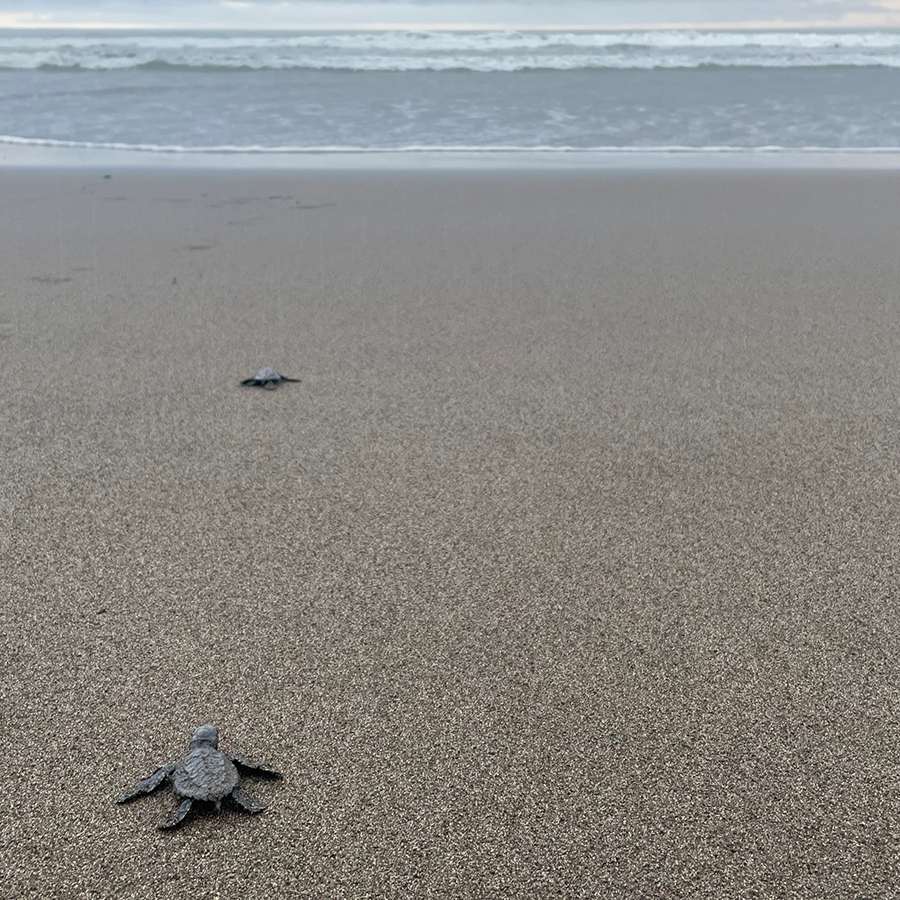
Once they are out of their shells, baby sea turtles face incredible odds. They head toward the sea, looking for that contrast in the horizon and the shining white foam of the breaking waves. They walk towards the light and have to survive a number of incredible predators and obstacles before they reach the water—birds, crabs, dogs, poachers. Their journey is long and perilous. They look so fragile and vulnerable that if we were to see them during their struggle to make it to the ocean we could easily think “why not improve their chances and give them a little lift, take them to the water where they could finally be safe.” But that would be a mistake, one that would probably cost them their lives.
Mother Nature is wise, and so was the mother of the little turtle who chose that secluded part of the beach, the one with the least artificial light pollution, away from the large house with the family dog, and very far from the restaurant with the sign announcing turtle soup.
But ours would not be a wise choice if we were to “help them” by picking them up. That long wobbling crawl over the sand is helping them “imprint” —forming a special bond with the composition of the sand that will help them survive years from now. But more importantly, at that crucial time of their young lives, that long journey will serve to strengthen their muscles—very important muscles they need to learn to use during their very important long crawl so they can hit the water swimming and avoid imminent drowning and escape from the many predators waiting for them in the water. So, if you absolutely need to grab them to help them escape from a trap or an obstacle, make sure you have the least contact possible and carefully hold them by the side edges of their shell, never by the fins or tail.
These wonderful little creatures, after 150 million years of existence, are now listed as vulnerable to extinction. We need to contribute to their survival, therefore it is important that we learn more about them and that we pass what we learn along.
EL CHOCO, COLOMBIA: THE INSPIRATION FOR OUR PROJECT
The region of El Chocó, in Colombia, is an area that extends from the jungles and swamps of El Darien, at the border with Panama, down the Serrania del Baudo and all the way south to the border with Peru. It is the only department in Colombia that borders both the Caribbean Sea and the Pacific Ocean. One of its municipalities receives up to 13,000 mm of rain a year—a record it holds—making it the wettest region in the world. The United Nations Development Program has cataloged it as a Key Biodiversity Area, as studies show it is one of the regions with the greatest biodiversity on the planet.
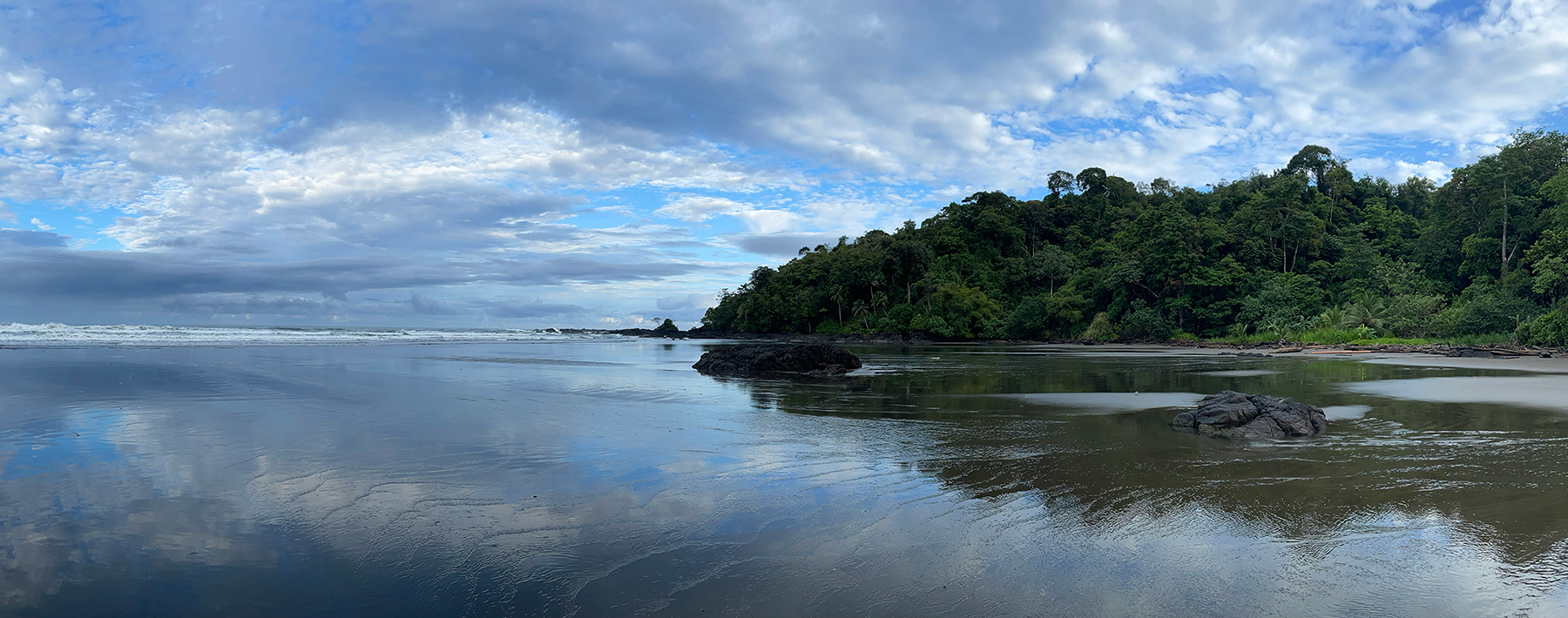
One of the most beautiful areas of El Chocó that we visited was Vanilla Beach, near El Valle, where the lush Darien Rainforest meets the Pacific. During low tides, the black sands formed mirrors with reflections of the sky so magical they inspired visions of the Porta Magicae everywhere we looked.
Every year, thousands of humpback whales leave the freezing waters of Antarctica and migrate north, with many of them aiming for the warm waters of El Chocó to give birth to their young. They love staying close to the coast, so you might even be able to see them from the beach, if you are lucky.
But something you will not miss, even if you are only scouting the horizon for whales, is the hundreds of tiny baby sea turtles coming out of their shells and exercising their little flippers for the first time on their long journey to the water. That’s how we met Hatchy, the hero of our coloring book featuring the baby turtles of El Chocó. Follow our project, contact us, and inquire how to give Hatchy a hand.
PLANNING ON VISITING EL CHOCO?
If you plan to visit the area, turtles start laying their eggs from June to December, and the babies are released to go for their first swim from September to January. However, we strongly recommend to consult local authorities and conservation groups and organizations for specific dates, as hatching and release times can vary by turtle species, weather conditions, and several other factors.
BRAAAAAK! YELLOW, BLUE AND RED : AMARILLO, AZUL Y ROJO
So the story goes, that a Venezuelan painter named Joaquín, while working in Caracas on a very large painting for a client, found a young macaw with an injured wing. He fed it and helped it through recovery. It was a yellow, blue, and red macaw. He called it Guaco, short for Guacamaya, the term used for macaws in Venezuela. Taught by the artist in his studio, Guaco learned really fast how to say “Venezuela” and “amarillo, azul y rojo” — yellow, blue, and red in Spanish — the colors of its plumage, but also the colors of the Venezuelan flag. The painter knew how special those three colors were to an artist. Yellow, blue, and red are the primary colors of the color wheel, and with them, a good artist can mix all the colors that exist in the universe! And Guaco was starting to recognize those colors while he painted. Guaco, Joaquín thought, was definitely a very magical Guacamayo, and he had found a new assistant.
Guaco, like all macaws, was extremely loud, especially in the mornings when the painter was still sleeping, and very, very messy. However, the painter had grown fond of Guaco. Away from his family while he worked on the painting, Guaco had become good company. He was seriously thinking about keeping it. But every time other macaws flew over the studio forming their usual racket as they flew by, the painter could see that Guaco looked up and got all excited. The painter knew Guaco needed to be with his family and friends too. So when Guaco was ready to fly, the painter said goodbye and let his painting assistant go free. Guaco must have returned to its flock and taught the others what it had learned, because people in Caracas now say that when a flock of macaws flies by and they yell “Venezuela!”, the macaws respond “Amarillo, azul y rojo, amarillo, azul, y rojo!”
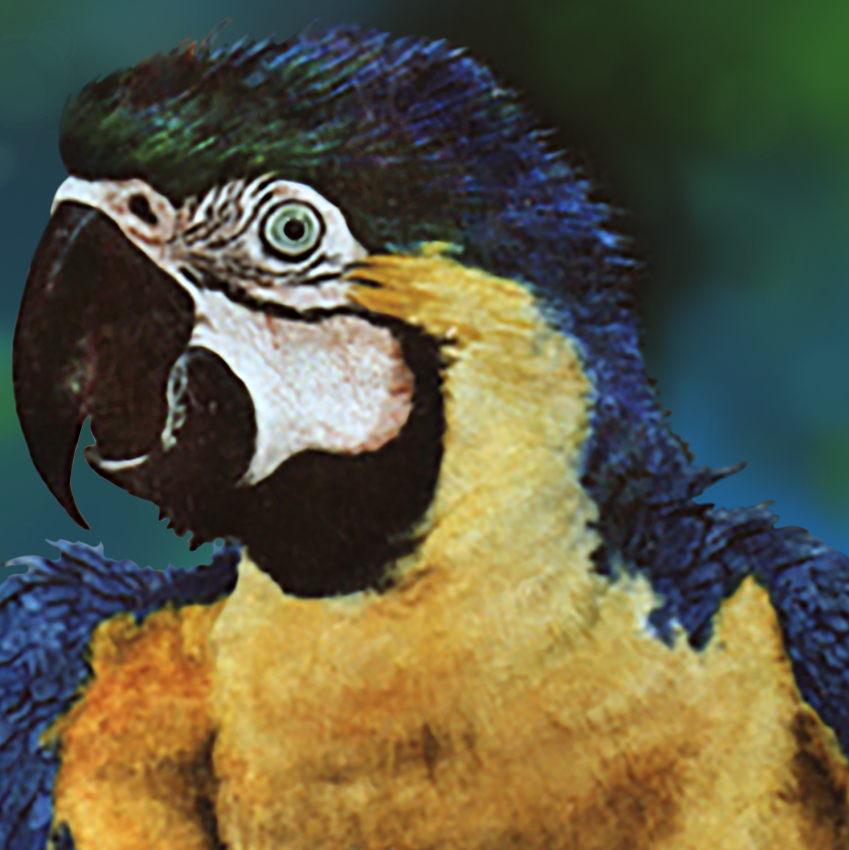
Macaws are among the most beautiful and intelligent of birds. They can grow up to 35 to 40 inches and have long colorful feathers. There are 4 species of macaws in Venezuela: the Flag Macaw (Ara macao), with yellow, blue, and red feathers, like Guaco in the story, that lives mostly in the Amazon regions and the plains; the Blue-and-Yellow Macaw (Ara ararauna)—like the one in the image above—which were first brought to be sold as pets and now fly in great numbers through the skies of Caracas; the Maracaná (Ara severus), of apple green color, lives mostly in the central areas of the country; and the Red-and-Green Macaw (Ara chloroptera), found now only in small populations to the west and east of the country.
Macaws pair for life and they can live very long lives, as long as a person, so when taught from a young age, they can learn to repeat many words and sounds. Unfortunately, this has turned them into targets for the illegal pet market. For this reason, poachers steal them from their nests in the rainforests and box them up, putting them in large containers to be shipped overseas. But the trips are long, hot, and very rough, and most do not survive. It is said that out of 40 or so sent as contraband in containers, only two or three survive. It has been very difficult to stop smugglers from exporting the baby birds, so the best we can do is to stop buying them as pets to discourage the trade. Such beautiful birds, most biologists agree, with such a wingspan and a vocalization that can be heard for miles in the rainforests, are meant to fly and roam free.
The story of Joaquin & Guaco is being created as part of the ‘Drawing Baby Animals’ Project in collaboration with Venezuelan biologists from The Foundation of University Students for Sustainable Development (FUNDES). Besides fostering empathy for animals in need and offering useful information about the species, the book is designed to include fun ways for young artists to learn about primary colors and what happens when they are mixed to create a variety of combinations. The project also features a section with a color wheel and pages to color. Please keep visiting this section for updates on Joaquin & Guaco and their painting adventures with Porta Magicae.
COLORING BABY ANIMALS
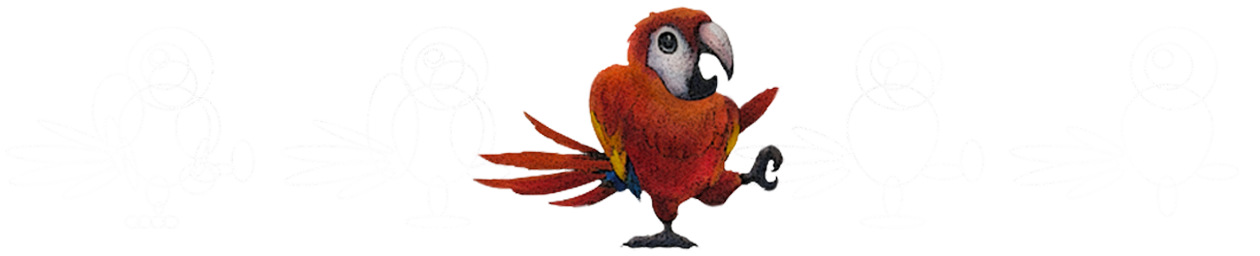
As part of our “Drawing Baby Animals” project, we are creating short, collectible videos to teach kids how to color animal species that are in need of attention, like Guaco, the Venezuelan macaw. We believe that we can help by starting a program with schools to teach children about the color wheel and color mixing while also sharing important information that could help with other conservation efforts in their communities. It can serve as a wonderful tool for teachers in their efforts to harness the power of art in conservation. The videos pair with the illustrated story “Joaquin & Guaco,” making the learning process more memorable and fun!
The story, the illustrations, and the color theory are designed to work with children 7 years old and up.
Longer, more advanced and complete videos for older kids and adults will become available for purchase, and part of the proceeds will go to partner institutions that are working toward the conservation of friends like Guaco, the Venezuelan macaw. Coloring books and printed materials can be made available for those communities with no access to the internet.
THE ORINOCO RIVER DELTA: THE INSPIRATION FOR OUR PROJECT
The carabel La Niña was leading the larger Santa Maria and the Vaqueños when they sighted beautiful lush green land and noticed the incredibly vast quantities of freshwater flowing into the ocean. No island could produce such amounts of freshwater—this was a new continent!
It was the 1st of August of 1498, and the sailor was Christopher Columbus while on his third voyage to America. He was about to set foot in South America for the first time, and the river that so impressed him was the mighty Orinoco.
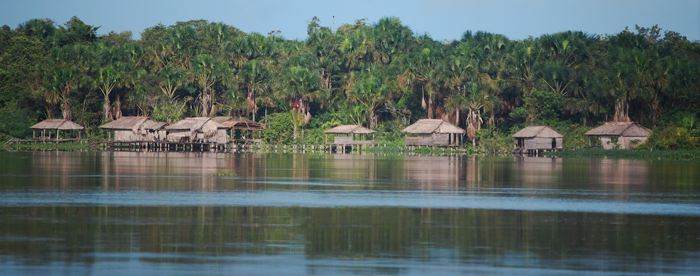
The houses where the indigenous peoples lived at the mouth of the Orinoco River Delta, built on stilts over the water, reminded Columbus of the construction method used in Venice, Italy, near his native Genoa. Inspired, he called the new land Venezuela.
Although the Orinoco is not one of the longest rivers, the amount of water it discharges into the Atlantic Ocean is extraordinary, ranking it as the fourth-largest river in the world in terms of water volume. Furthermore, something unique occurs in the Orinoco river basin. There is a natural waterway, the Casiquiare canal, that connects it with the Amazon River basin, which includes the Rio Negro as a tributary—this is a phenomenon not seen elsewhere on Earth between two major river systems. You can actually navigate from the Amazon River Delta all the way to the Orinoco Delta, with the flow direction of the Casiquiare changing depending on which area is carrying more water as the seasons change. This creates an incredibly extensive aquatic highway for the species of Amazonia. The considerable volume and connections of the Orinoco River system make it one of the most significant globally, as anything that affects its waters will ultimately affect us all.
The Orinoco Delta is home to over 1,000 fish species, more than 1,000 bird species, and well over 100 mammal species. The shy capybara, the anteater, and the giant otter share habitat with jaguars, ocelots, and five other species of wild cats. Dolphins, piranhas, the Orinoco crocodile, and electric eels dominate the waters, occasionally making room for the mighty anaconda. Spider monkeys and the red howler monkey can be heard as they traverse the jungle canopy, and toucans, hoatzins, and our friends from our story, macaws — or guacamayos — add splashes of color to the lush green forest that always flanks the many rivers, caños, and canals of the delta.
The Warao people, or ‘People of the Canoe,’ live in the delta. They are a beautiful indigenous group who have lived in the jungles of the delta for thousands of years, long before Columbus arrived in the American continents. Their lives have always had a strong connection to the river, the jungle, and the animals of the delta. They create exquisite baskets, hammocks, and colorful necklaces crafted with beads.
Unfortunately, because of the enormous riches beneath the soil — the area under and surrounding the Orinoco River is home to one of the world’s largest oil reserves, as well as a wealth of other minerals — many of their communities have been adversely affected by mining, prompting large numbers to migrate toward Guyana and Brazil. With such a crucial ecosystem at stake, significant conservation efforts are vital.
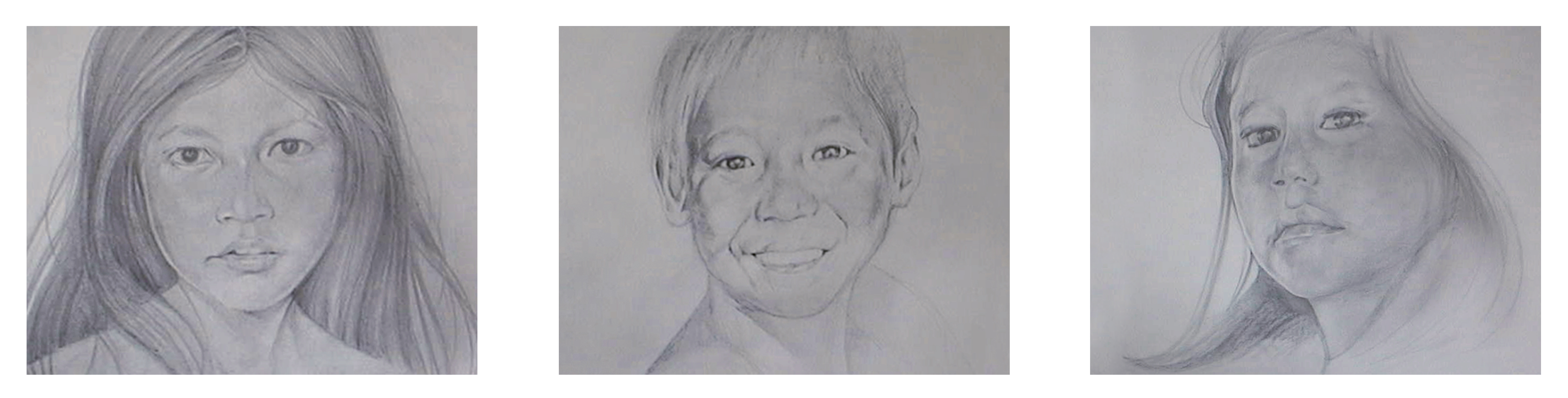
Kids from the Warao Tribe – Tiger Island – Orinoco River Delta
PLASTICS IN THE GALAPAGOS ISLANDS
Nestled in the crystal-clear waters of the Pacific, the Galapagos Islands emerge as a testament to nature’s artistry—a kaleidoscope of life where the rarity and diversity of flora and fauna defy imagination. Belonging to Ecuador, yet about 1,000 miles from the mainland, each island is a unique jewel, brimming with species found nowhere else on earth, living testaments shaped by forces of isolation and evolution. This archipelago is home not only to playful sea lions, wise old tortoises, and iridescent hummingbirds but also represents a delicate Eden, emphasizing the importance of conservation and the interconnectedness of our world’s ecosystems. The Galapagos beckons with wonder while echoing a vital message of balance and respect for the natural world.
The remoteness of the islands from the mainland and from each other has contributed to their remarkable biodiversity. However, this has not shielded them from a new and very aggressive invader: plastics.
In our quest to find the magical door, we traveled to the Galapagos and sailed through the islands to research, photograph, illustrate, and find inspiration for writing about this incredibly beautiful yet fragile ecosystem. During our journey, ‘The Vanishing Hawk,’ a fully illustrated adventure book, began to take shape. In the story, Anna, a young girl from Boston, is visited by a hawk carrying a piece of plastic in its beak. Holding the plastic, she realizes that if she really makes an effort and pays careful attention, she can somehow understand the hawk. Following its instructions, she travels back in time through the Porta Magicae to the Beagle, a ship anchored in the crater of a volcano in the Galápagos Islands and embarks on a mission to save the hawk’s species and that of all his friends—before they vanish. The book is designed to raise awareness about the dangers plastics pose not just to the vulnerable Galapagos Hawk, but to all species on the planet, including ourselves.
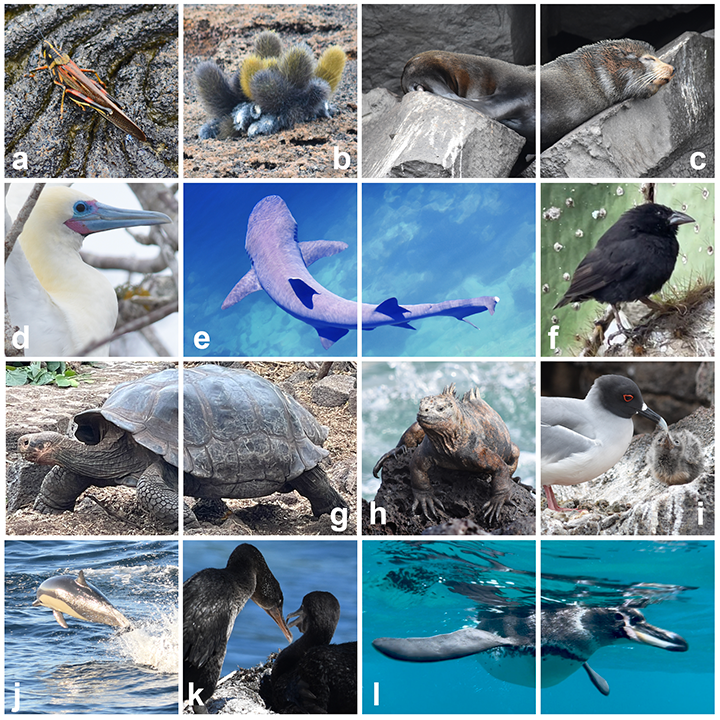
The Galapagos Islands are home to many species of plants and animals found nowhere else (endemic) on the planet. Match the species on this image to their native islands below!
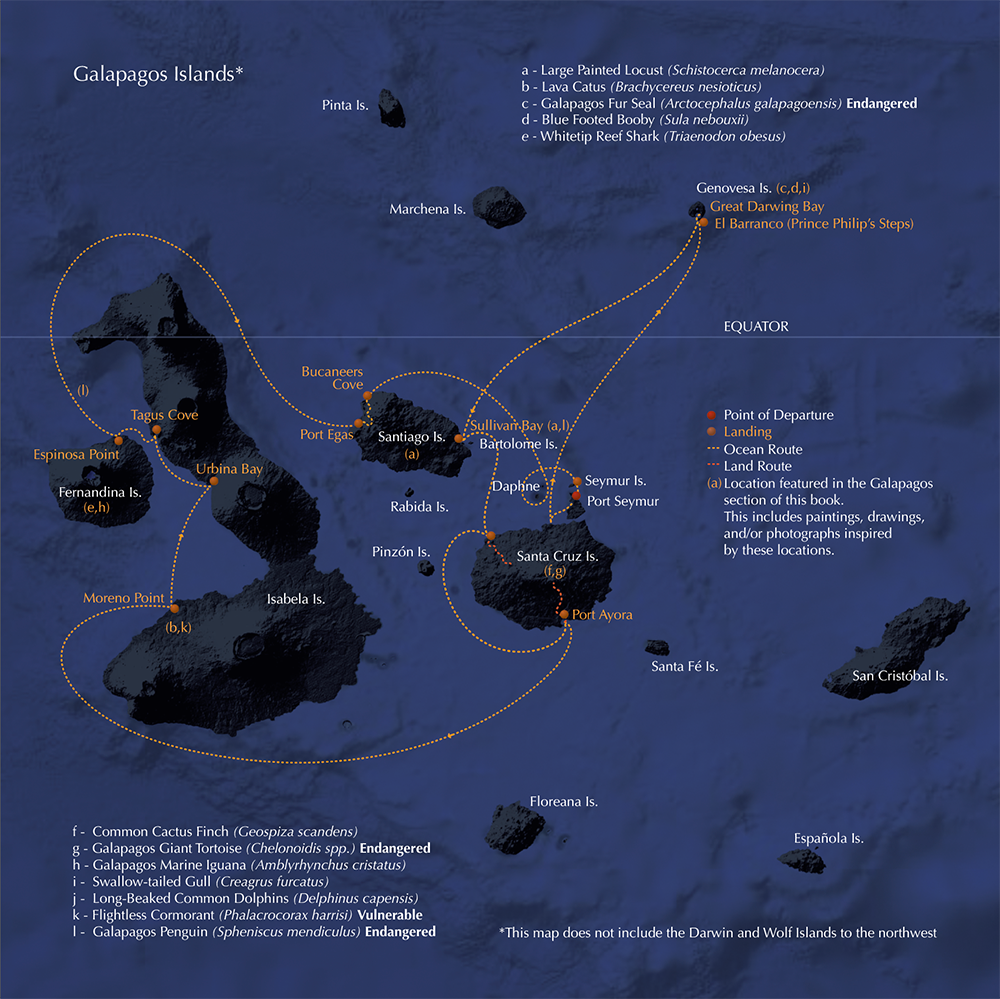
In the spirit of adventure that Porta Magicae inspires, four members of the team sailed through the Galapagos Islands. We wandered through its rugged lava fields, swam with sea turtles, marine iguanas, flightless cormorants and penguins, and even had an amazingly close conversation with our friend, the vanishing hawk.
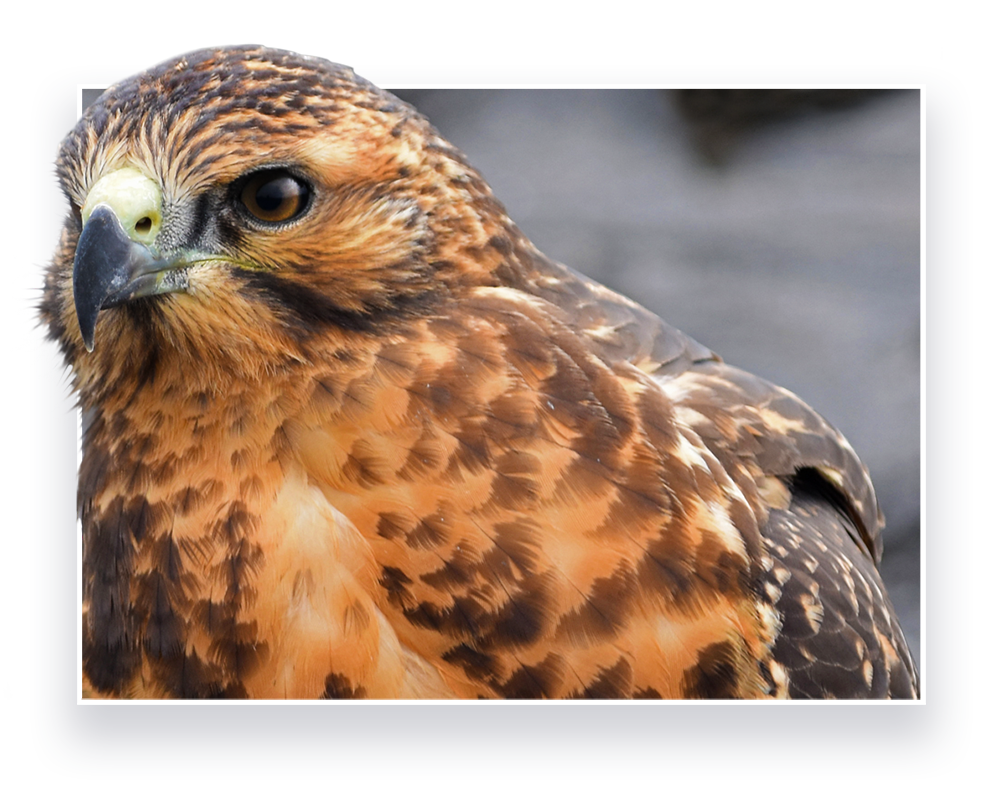
We met a very magical—and curious—hawk
Imagine being Charles, not the white bearded gentleman we find in Biology books, but a young man only 22 years old, fresh out of the university, and stepping onto a ship that would travel for almost five years and carry you into the pages of history. That was Charles Darwin, an adventurer with a keen eye for nature, who boarded the Beagle not knowing he’d soon unlock secrets of life that would leave the world in awe for centuries to come.
While exploring the rough and untamed landscapes of the Galapagos Islands, he encountered creatures so bizarre and so unique that to him they must have seemed to be from another planet. Darwin was like a detective, piecing together clues from the beaks of finches and the shells of giant tortoises. He was amazed to discover that these animals had changed and adapted to survive on these remote islands. It was like nature’s own laboratory, where every day was full of “eureka!” moments. This journey ignited a spark within Darwin, leading him to a groundbreaking theory that would forever change our understanding of life on Earth.
In the Porta Magicae story “The Vanishing Hawk,” our friend Anna travels back in time to 1835 and becomes friends with a young boy assisting Charles Darwin on his research. Together, they embark on an extraordinary adventure and explore the Galapagos with their perfect assistant—a magical Galapagos hawk.
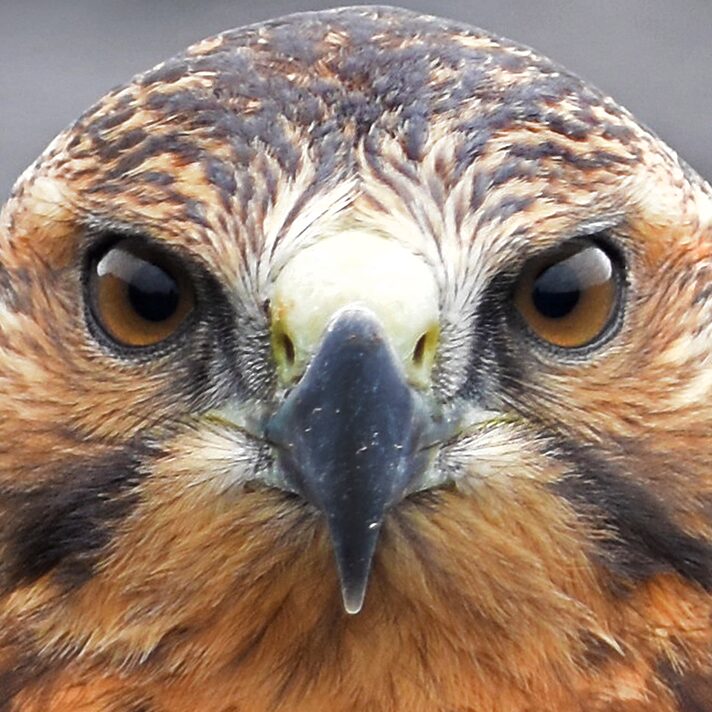
The Porta Magicae team tried to follow in Darwin’s footsteps as we traveled through the islands doing research to create this story for you. We visited Santiago, an island Darwin camped on for nine days and described as fantastic, so we were eager to explore it too. As we anchored, we saw in the distance a hawk flying near the summit of the island’s volcano and felt very lucky to have at least spotted it, even if it was so far away. But as we took pictures and carefully walked through the lava fields, as if out of the pages of a fantasy novel, we had our own magical experience: the mighty Galapagos Hawk swooped in for an up-close encounter, landing just twenty feet from us, paying attention to everything we did. Then he opened his wings, and in a beautifully swift move, flew straight at the camera, landing right next to us—so close that anybody else who saw this would have to believe we were truly having a conversation. This beautiful meeting offered not only an unforgettable moment from our journey but also created a connection with us that has helped us better understand the plight of his and his friends’ survival.
Now back in our studios, we are working hard to put all our research and artwork together. We are organizing the hundreds of photographs we have of the magical hawk and all his friends. We are consulting with experts to make sure that we create a book that is accurate and exciting for you. ‘The Vanishing Hawk’ is evolving into a beautiful story.
Read on, so you get ideas on ways you and your friends can help with the survival of all the species everywhere.
Let’s try together to make sure they have a story that never ends.
Plastic: an aggressive invader
Under construction—coming soon! Sorry about the inconvenience.
What can you do to help?
Under construction—coming soon! Sorry about the inconvenience.