
PORTA MAGICAE
THE ARCHIVES
“Whisperings of Porta Magicae can be found in every corner of our world since time immemorial – if one only knows where to look.”
On this page, for the first time since who knows when, these archives come to light.
We have traversed the globe in search of such stories, and as the years accumulate, so our assorted interviews, illustrations, photographs, journals, and scribblings amass into an magical archive – one that we share with you here.
Proceed with an open mind and an open heart, and the universe may open its doors to you, too.
The Appalachian Sketchbook
The sketchbook we found at an old antique shop in Appalachia contains over 100 drawings, sketches, and rubbings, 13 maps, 7 diagrams, 23 technical and architectural plans and elevations, and thousands of dates and calculations that we are still deciphering. Its numerous accounts and logs are written in 17 different languages and dialects, with dates in the logs spanning over 300 years—yet, according to an expert we consulted, all are penned in what seems to be the same hand.
We’ve researched the design style, materials, and craftsmanship, leading us to three different origins. The paper, leather, and design style suggest the northeastern Spanish region, with genuine materials used in medieval Catalonia. However, the cover’s lining appears to be 16th-century Venetian silk, confusing our expert friends due to its resemblance to patterns found in books printed by the prestigious Riverside Press in Cambridge, Massachusetts, during the 1880s. It seems a bookbinder, well-versed in Catalan leatherwork, combined Spanish paper and leather with Venetian silk, finishing the silk lining with American pattern designs from the 19th century.
At the end of the day, we know that what we hold in our hands—one way or the other—is a truly magical book. And as you might have already guessed, the mystery behind the making of the book is all we need as an excuse to visit Boston, to fly to Venice, and tour all the exciting Catalonian mountain towns — which means… “Hola Barcelona, abre tu puerta a Cataluña, that here we come!”
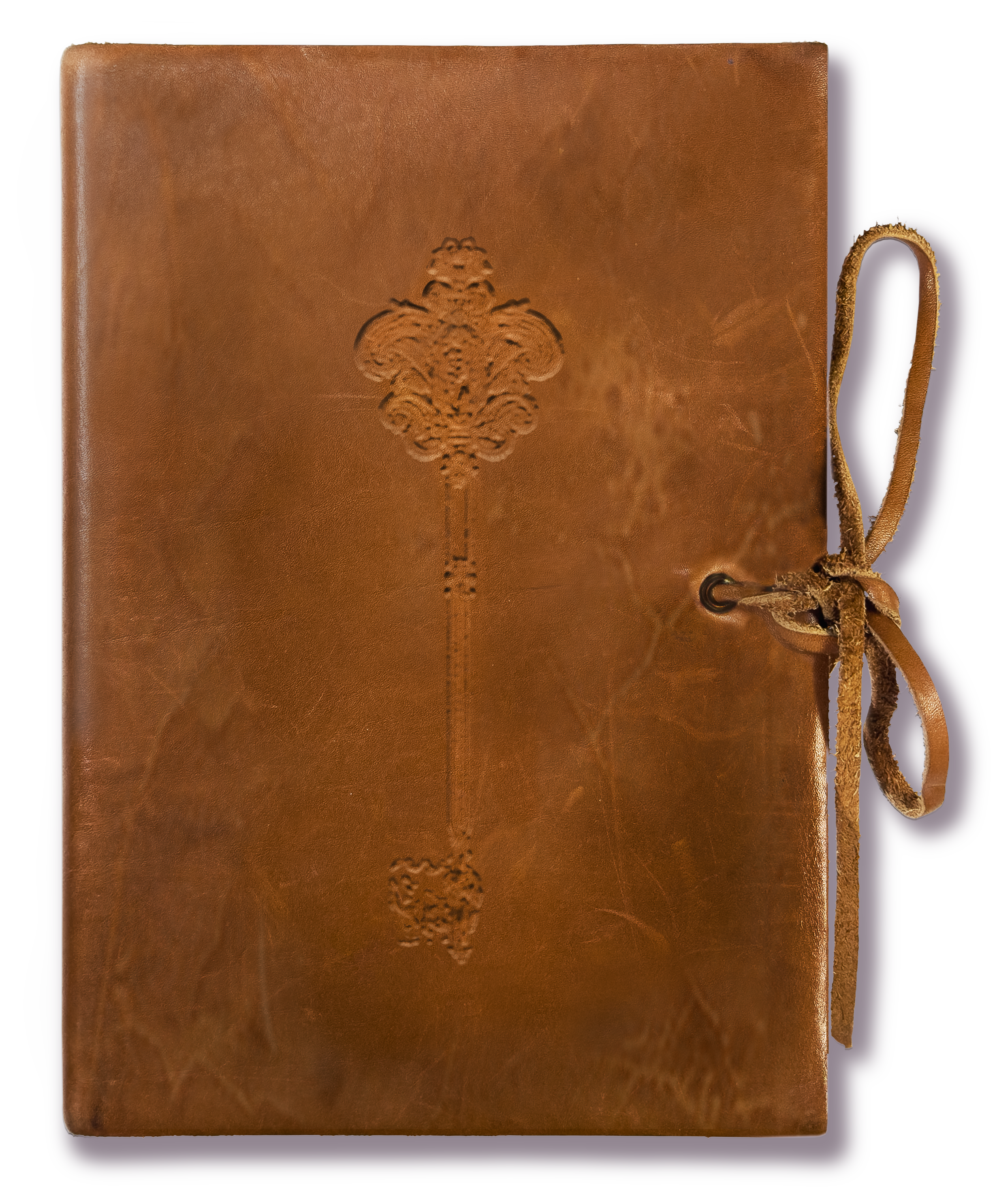
Archive # T.US: I-IV.VI.MMXVIII
The Porta Magicae Sketchbook, with its cover embossed with the Magic Key
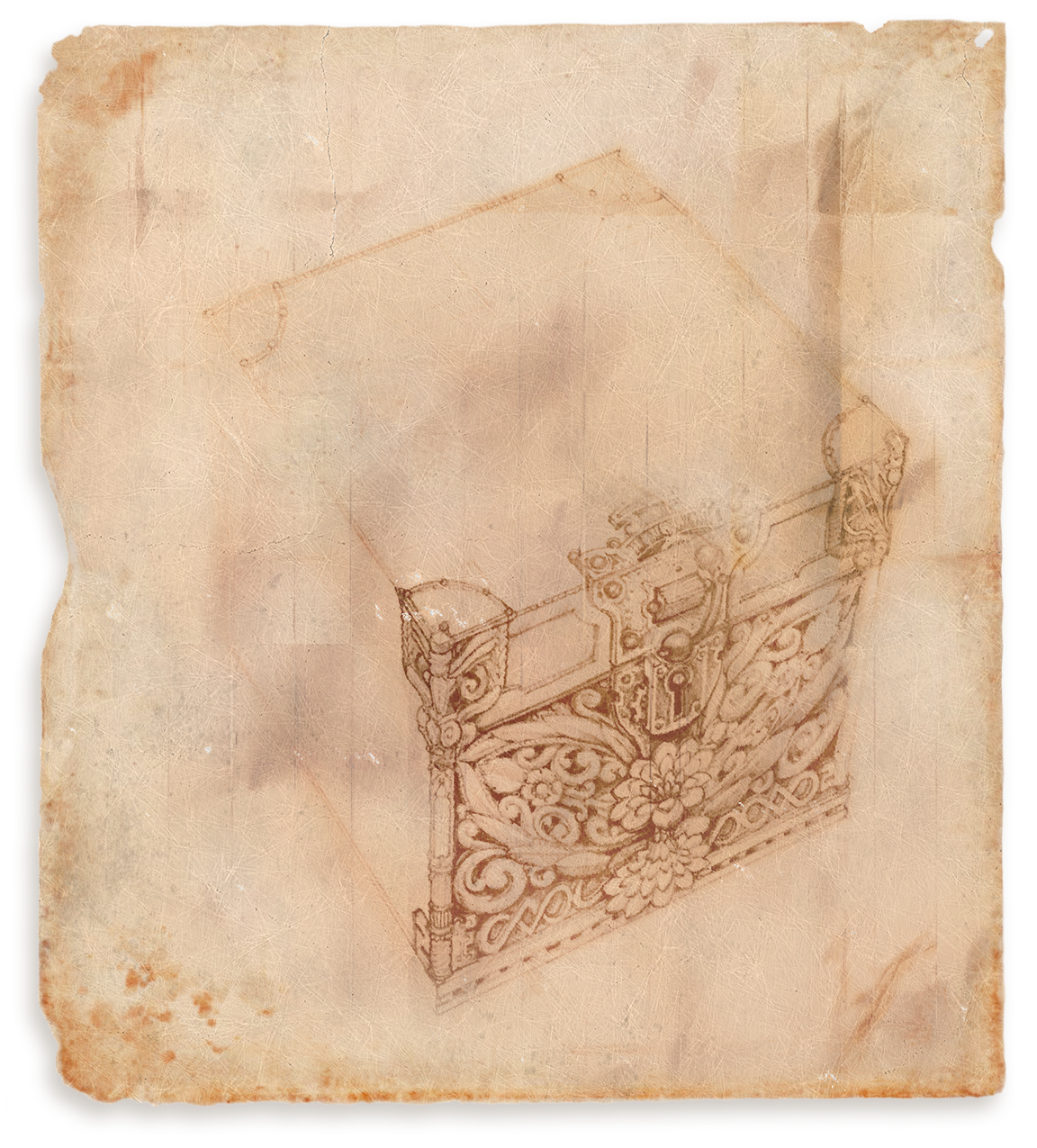
Archive # T.US: II-IV.VI.MMXVIII
The sketchbook we found at the old antique shop in Appalachia contains over 100 drawings, and many are loose pieces of thin paper in delicate condition in need of restoration. One of these was an unfinished drawing of a box—a box to which we’ve now, during our travels, found references, descriptions, and smaller sketches and rubbings hinting at the designs of three of its—according to the detailed description—12 sides, something we are yet to understand.
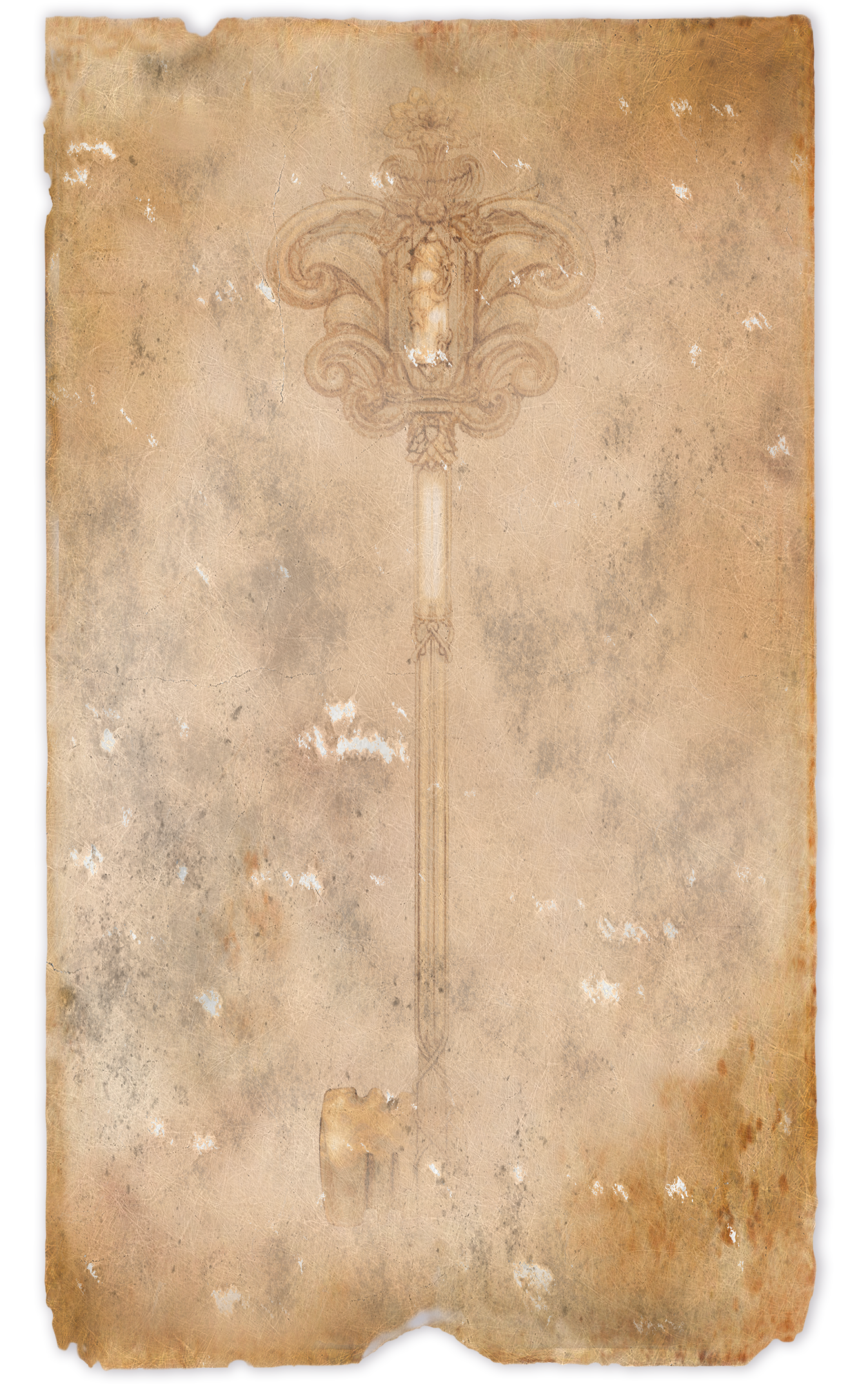
Archive # T.US: III-IV.VI.MMXVIII
Of all the keys drawn in the sketchbook, this one is the most detailed. The author describes this particular version as of the utmost importance, as it includes a design of the “Porta Magicae” at its center and has what he later calls the “Amäy Non” crystal embedded into the door.
The Key
One of the objects that holds incredible significance for the mysterious author of the sketchbook is a very particular key. There are several partial drawings which, although unfinished, exhibit great detail. Different textures have been rendered to represent very distinctive materials. The head, astonishingly, appears to be wooden, and its design shows a series of leaves or petals that unfurl in perfect spirals, reminiscent of cornucopias. It is crowned by what looks like a lotus with numerous petals emerging from what seems to be an ancient sundial, and the shading used suggests it is made of some kind of metal. Every design is impressive, but it is the center of this wooden bow that holds the most curious design. A crystal that shines as if it could emit its own light—adorned by a moon, a spiral, and a little star—is embedded within what the author refers to as “The Porta Magicae,” the “Magic Door.” The door, although drawn at such a small scale, is shown in perfect detail. Different depictions of this door appear throughout the sketchbook, showing minor variations, with this one being the most prevalent. A long shaft emerges from an extension of the lotus flower at the base of the bow. It starts with a small cylindrical glass chamber which seems to be traversed by a bright beam of light, and then disappears, transitioning into a long metal shank that leads to a lavishly designed collar. It all culminates in a very particular bit, astonishingly depicted as if carved from some kind of granite or stone with very precise cuts for its key wards. It wouldn’t be too far-fetched to conclude that if the magic door, the Porta Magicae, really exists, this would be the Magic Key.
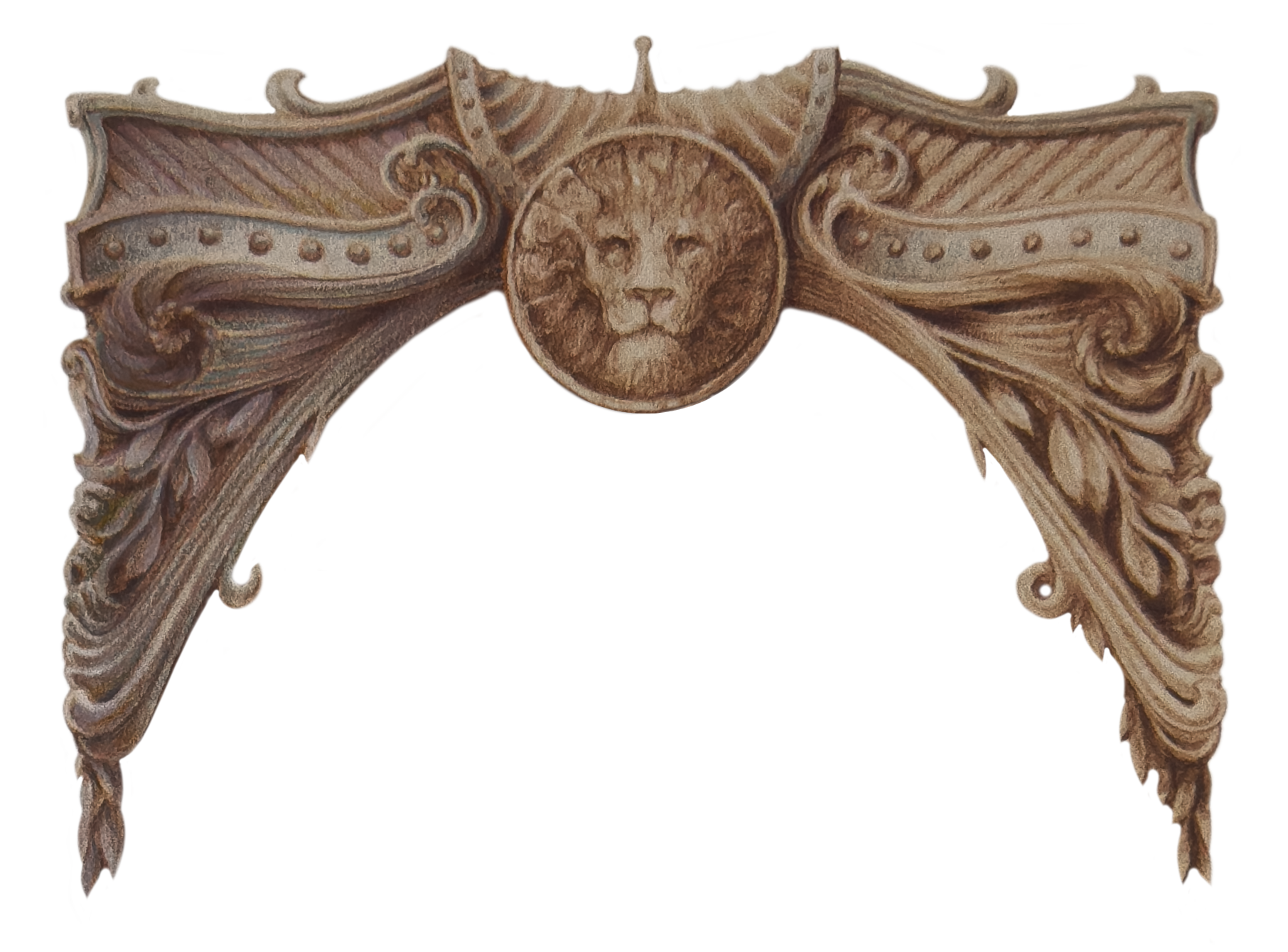
Door Crown – Archive # T.US: IV-IV.VI.MMXVIII
A medallion featuring the face of a lion and an ancient Roman sundial are the centerpieces of the door’s crown, an intricate design of twisted stylized vines, leaves, and other organic motifs that seem to embrace and protect the entire door from above.
The Door
There are 22 sketches and drawings related to the door in the sketchbook. Most of them are details, others are unfinished or have missing sections, and there are—what seem to be—five slightly different versions of the door. The door is designed to stand like a floor mirror. It has a strong base, a horizontal wood panel covered by a metal plate that is attached by a line of large bolts, all supported by two sculpted legs that resemble the lion paws used in ancient Greco-Roman designs and later during the early 1700s and the Regency Period of the 1800s. The door’s threshold features a very particular welcoming step. A metal scroll unfurls from side to side with an inscription carved in Roman lettering: LIBRIS PORTA MAGICAE TEMPO MUNDI. Five words in Latin, similar in style and design to those used in ancient Roman times. In Latin, LIBRIS (the plural of Liber) means “Books.” The word PORTA can be translated as “Gate,” “Door,” or “Portal.” MAGICAE means “Magic.” TEMPO translates as “Time,” and MUNDI means “World” — BOOKS GATE MAGIC TIME WORLD. Latin is a flexible language with free word order due to its inflected nature. Word endings indicate the word’s role in the sentence, such as subject or object, rather than the word order. Although Latin sentences often follow a Subject-Object-Verb pattern, words can be rearranged for emphasis or rhythm. Thus, if read as a sentence, it could be interpreted as “Books of the magic gate of the time world,” or “Books are the magic gate to the world of time.” The phrase could suggest that books serve as a magical gateway to the world across time. During ancient Roman times, books were very popular, yet they only existed in the form of scrolls, similar to the one on the doorstep. The author, drawing on other references from elsewhere in the sketchbook, suggests that by stepping over the scroll and through the portal, one can travel through time to anywhere in the world. Two words he repeatedly uses to describe this phenomenon throughout the sketchbook are “anywhere” and “anywhen.”
The image of the door shown next has been composed using the different sections and details drawn in the sketchbook, including the scroll, which displays the five words as discussed, in the order that our mysterious author maintains in numerous annotations.

Door Rendering – Archive # T.US: V-IV.VI.MMXVIII
This rendering is a composite made from the different detail and partial drawings found on the sketchbook (Archive # T.US: I-IV.VI.MMXVIII)
The casing of the door is made out of wood. Each side of the symmetrical design of the casing starts with a column or pilaster pedestal, with simple, flat shafts. The outer edges of the casing are decorated with stylized vine and leaf designs—as those used on doors of the Art Nouveau period of the 1890s—that twist upwards, reinforcing the side panels.
The door panel is formed from eight wood boards. Four form the two side stiles, which house two highly ornamented rocaille hinges on the left side, and the door handle on the right side—all reminiscent of the Rococo interior design period of early 18th century Paris. The four center boards encase a glass panel that has a flower design base—a design that is repeated on the key (Archive # T.US: III-IV.VI.MMXVIII) and carved on the front panel of the box (Archive # T.US: II-IV.VI.MMXVIII). The shape of the glass panel, or mirror, ends with a double set of curls and is pointed like an arrow, encasing a sphere at its tip. This sphere has markings resembling the parallels and meridians used in cartography and scale models of globes representing planet Earth. A smaller sphere embedded into the wood—judging by its relative scale and distance to the Earth sphere—might have being placed to represent the moon.
The entire door panel is a vertical rectangle that repeats the mirror’s pointed upper end and, like the mirror, leaves a space at the top—resembling those on Chippendale cabinet designs—for a circular medallion from the door crown above to fit into when the door is closed. The medallion has a frontal-facing lion’s head crafted out of metal. His piercing eyes seem to stand watch over those who dare cross the door’s threshold. The crown, a work of art with twisted stylized vines, leaves, and other organic elements, seems to embrace the entire door from above. The upper part of the door crown ends with a metal band holding an ancient Roman sundial, just above and behind the lion head medallion.